

AI is no longer optional in education, yet many students are not taught how to use it properly, ethically, or effectively. Global education and policy bodies have warned that the rapid integration of artificial intelligence into learning environments has outpaced formal instruction on responsible and critical AI use (UNESCO, 2023; OECD, 2024). In addition, there is a growing consensus that future employers will increasingly require individuals with practical AI skills to perform a wide range of tasks across sectors. This shift means that students will need to demonstrate AI literacy and applied AI competencies when entering the job market (World Economic Forum, 2023; World Bank, 2019).
However, despite this growing demand, a significant AI skills gap persists(OECD, 2024; UNESCO, 2023).
Preparing Students for a Future Powered by AI
Artificial intelligence is expected to be embedded across all professions, including education, business, health, law, and technology. The World Economic Forum projects that by 2030, analytical thinking, technological literacy, and the ability to work effectively with AI will be among the most critical skills for the future workforce (World Economic Forum, 2023). Students who lack AI literacy therefore risk falling behind, regardless of their academic qualifications, as employers increasingly prioritise adaptive, digitally fluent, and AI-capable graduates.
Why AI Study Circles Matter
The future belongs to students who can think critically, learn efficiently and use technology responsibly. However, most students are not formally taught these skills.
Through our AI Study Circles, students gain practical, everyday skills on how to use Artificial Intelligence to support and strengthen their academic journey. We equip students with the tools, confidence and discipline to integrate AI into their daily study routines. This helps them to learn smarter, understand faster and stay ahead in a world where AI is central to education, work and life.
AI Study Circles give students a clear advantage by teaching them how to:
- Use AI to clarify difficult concepts instead of memorising blindly
- Enhance research, writing and critical thinking, not replace it
- Organise and manage study routines more effectively
- Ask better questions and explore ideas more deeply
- Learn from multiple sources faster and with greater understanding
In our programme, AI becomes a trusted learning partner not a shortcut.
Weekly Mentorship for Continuous Improvement
Students are not left to figure things out on their own.
Each week, students participate in guided study sessions designed to refine how they use AI and strengthen their academic strategies. These sessions focus on building skill, not dependency.
Students learn how to:
- Review and improve their study habits
- Write stronger prompts and interact with AI more effectively
- Validate and verify AI-generated information
- Use AI strategically for tests, assignments and exams
- Strengthen understanding across all subjects
This ongoing mentorship ensures students grow steadily throughout the semester and master the responsible use of AI for learning.
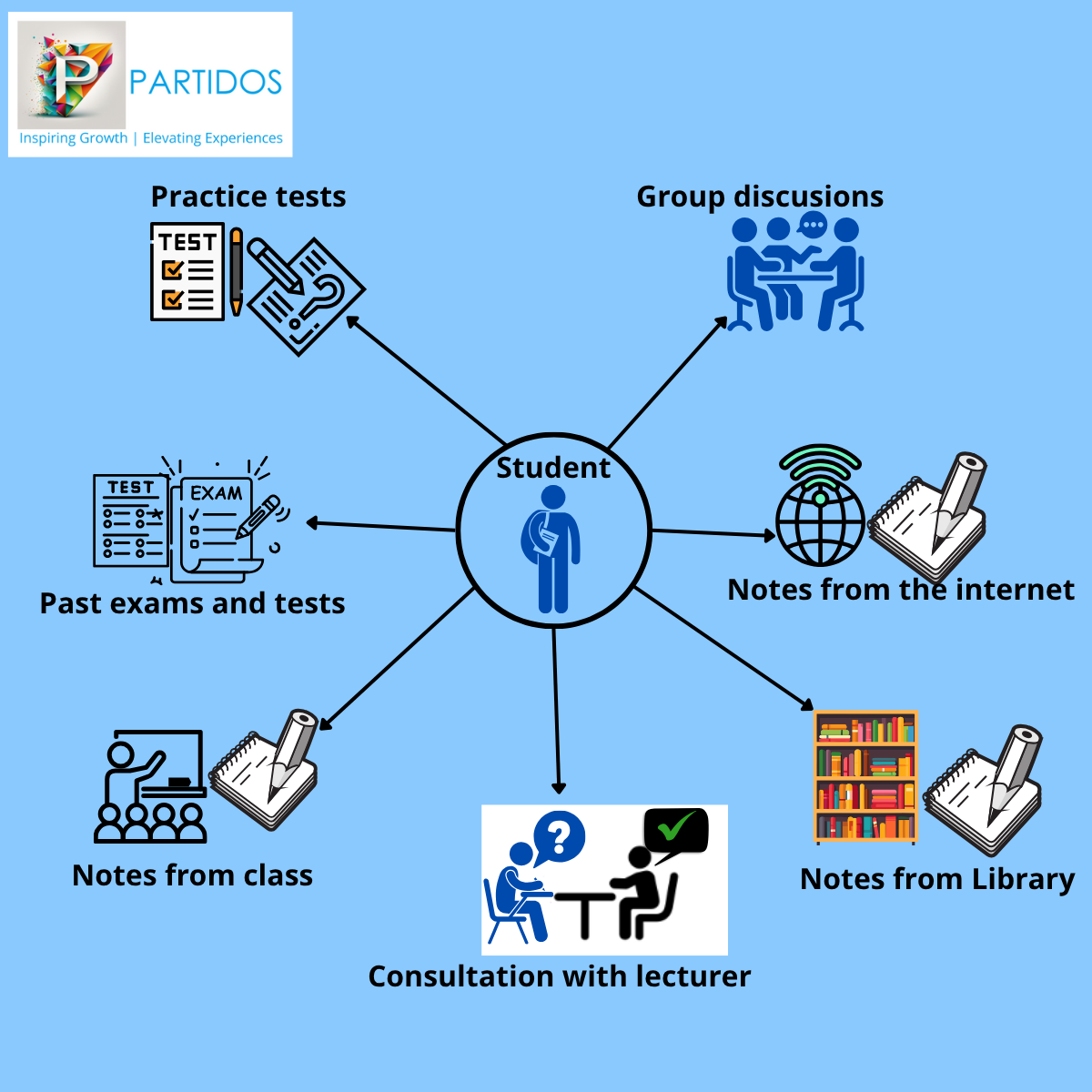
Use AI to seamlessly support every part of your learning journey

AI study Circles and future work
Our AI Study Circles are designed specifically to address this gap and respond to the evolving demands of the future of work. The programme equips students with practical AI literacy, ethical awareness, and critical judgement, enabling them to use AI as a support for learning, problem-solving, and decision-making rather than as a shortcut. As AI skills are embedded into everyday academic routines students develop the competencies identified by global labour and education bodies as essential for future employability. Partidos aims to bridge the gap between education and the AI-enabled workplace by providing structured, guided learning environments where students build confidence, discipline, and responsible AI practices.

References
World Economic Forum. (2023). The future of jobs report 2023. World Economic Forum.
https://www.weforum.org/reports/the-future-of-jobs-report-2023
World Economic Forum. (2025). Why AI literacy is now a core competency in education. World Economic Forum.
https://www.weforum.org/stories/2025/05/why-ai-literacy-is-now-a-core-competency-in-education/
Organisation for Economic Co-operation and Development. (2024). Bridging the AI skills gap. OECD Publishing.
https://www.oecd.org/en/publications/bridging-the-ai-skills-gap_66d0702e-en.html
Organisation for Economic Co-operation and Development. (2021). OECD digital education outlook 2021: Pushing the frontiers with AI, blockchain and robots. OECD Publishing.
https://doi.org/10.1787/589b283f-en
United Nations Educational, Scientific and Cultural Organization. (2023). Guidance for generative AI in education and research. UNESCO.
https://www.unesco.org/en/articles/guidance-generative-ai-education-and-research
United Nations Educational, Scientific and Cultural Organization. (2021). AI and education: Guidance for policy-makers. UNESCO.
https://unesdoc.unesco.org/ark:/48223/pf0000376709
World Bank. (2019). World development report 2019: The changing nature of work. World Bank Publications.
https://www.worldbank.org/en/publication/wdr2019
World Bank. (2020). Digital skills: Frameworks and programs. World Bank.
https://www.worldbank.org/en/topic/digitaldevelopment/publication/digital-skills-frameworks-and-programs


